Your Cart
Your cart is empty.
Continue shopping

Aesthetics 101
In short: there's no universal treatment. Laxity responds to radiofrequency, texture to microneedling, spots and redness to laser, volume loss to fillers, and expression lines to neuromodulators. Most concerns combine several causes, which is why a staged plan produces better results than a single isolated treatment.
At Clinique AMÉ, that's the logic behind every plan we build. Here's how to navigate it.
Why "which treatment" is always the second question
Aesthetic medicine has a sequencing problem. People often arrive having already chosen their treatment — seen on social media, heard from a friend — and the appointment becomes order fulfilment.
The issue: the most popular treatment isn't always the one that addresses your concern.
Dull skin can come down to hydration, pigmentation, cell turnover or sleep. A face that seems to be "sagging" can involve loss of skin firmness, loss of bone or fat volume, or both.
The right question isn't "which treatment?" but "what's causing what I'm seeing?"
The matching table
| Your concern | What usually causes it | Relevant approaches |
| Laxity, loss of firmness. | Collagen and elastin degradation. | Monopolar radiofrequency (XERF), RF microneedling (Potenza), collagen biostimulators. |
| Less defined jawline. | Loss of firmness plus volume loss. | Radiofrequency, fillers, biostimulators. |
| Brown spots, lentigines. | Uneven melanin production, sun exposure. | Pigment laser (DermaV), chemical peel, topical protocol. |
| Redness, capillaries, rosacea. | Visible dilated blood vessels. | Vascular laser (DermaV). |
| Uneven texture, enlarged pores. | Slowed cell turnover, scarring. | Microneedling (Ultra), RF microneedling (Potenza), peel. |
| Acne scarring. | Fibrosis and dermal tissue loss. | RF microneedling (Potenza), microneedling (Ultra), peel depending on type. |
| Expression lines (forehead, crow's feet). | Repeated muscle contraction. | Neuromodulators. |
| Hollowing, volume loss. | Bone and fat resorption. | Fillers, biostimulators. |
| Dullness, lack of radiance. | Cellular buildup, dehydration. | Facials, light peel, mesotherapy. |
| Dehydrated skin. | Impaired skin barrier. | Facials, topical protocol, mesotherapy. |
This table is a starting point, not a diagnosis. Several concerns share causes, which is precisely why assessment matters.
The main treatment families
Technologies
These use a form of energy — radiofrequency, light, micro-needles — to trigger a biological response in the skin.
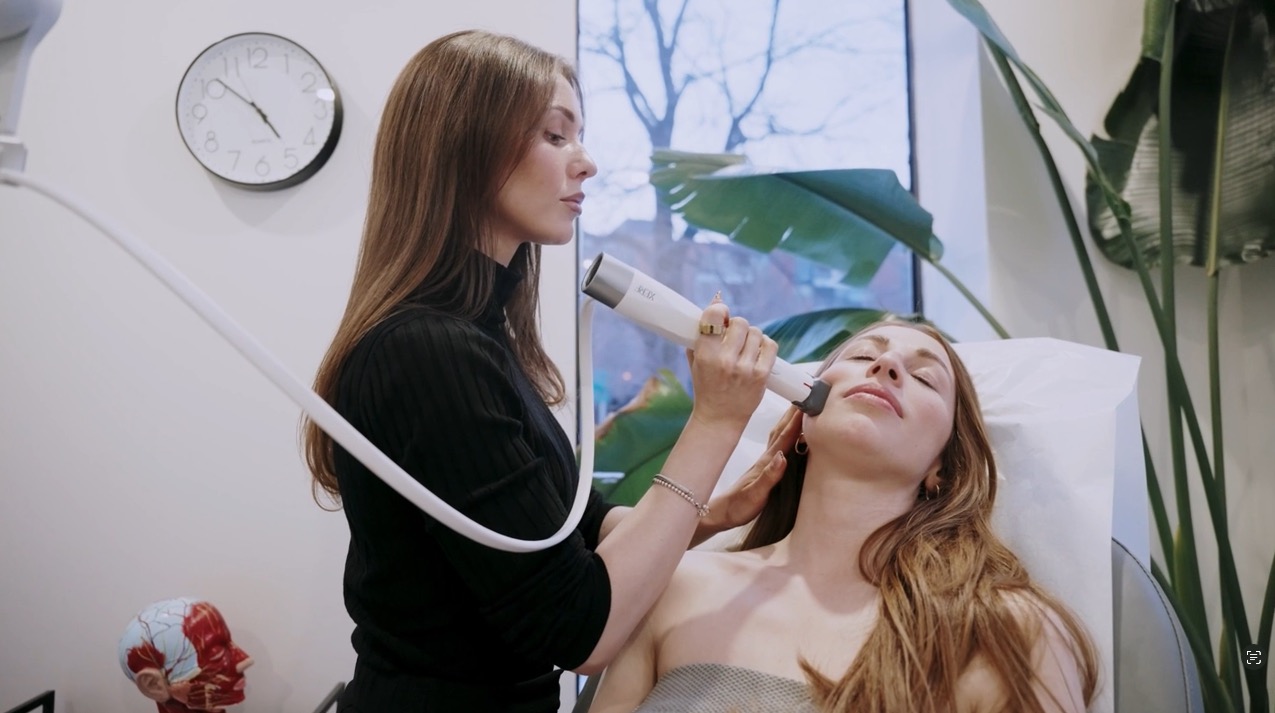
Monopolar radiofrequency (XERF). Heats deep layers to contract existing collagen and stimulate new collagen production over three to six months. Targets laxity and firmness. Minimal downtime.
RF microneedling (Potenza). Combines controlled perforation with heat. Works strongly on texture, scarring and pores, with more noticeable recovery than radiofrequency alone.
Microneedling (Ultra). Controlled perforations that trigger skin repair. Addresses texture, fine lines and renewal, without deep thermal action.
Vascular and pigment laser (DermaV). Selectively targets haemoglobin and melanin. Treats redness, capillaries, controlled rosacea, sun spots and uneven tone.
Treatments
Professional facials. Deep cleansing, exfoliation, extraction and hydration. Improve radiance and skin quality in the short term, and prepare the ground for more technical treatments.
Chemical peels. Controlled exfoliation of superficial layers. Depending on depth: dullness, texture, mild pigmentation.
Add-ons (exosomes, boosters, PRP). Layered onto a base treatment to support repair and skin quality.
Injectables
This category is strictly a medical act.
Neuromodulators. Temporarily reduce contraction in specific muscles, softening expression lines.
Fillers. Restore volume in targeted areas.
Collagen biostimulators. Stimulate your body's own collagen production over several months, rather than adding immediate volume.
Please note: for every new patient, a Consultation 360 is mandatory before any injectable treatment. At Clinique AMÉ, it's led by Amélie Castonguay-Hudon, nurse clinician, or by Dre Rita Mikhaël, our physician. It documents contraindications, assesses anatomy and builds a coherent plan. It isn't a commercial formality — it's a safety condition.
Our other categories — technologies, treatments, hair health — are open to direct booking.
Why a staged plan produces better results
A face almost never has just one concern.
Someone who comes in because they "look tired" often presents a combination: some laxity, uneven tone, volume loss under the eye, and thickened texture. Treating only one of these gives a partial and sometimes unbalanced result.
A staged plan establishes a logical order. Some sequences matter:
-
Skin quality is often addressed before volume treatments — the result looks more natural.
-
Pigment protocols start more easily in fall or winter, when sun exposure is easier to control.
-
Some treatments can't be combined on the same day and require spacing.
That's what the Consultation 360 produces: a written plan with steps, intervals and reasons, supported where needed by our « Le Dôme » imaging analysis.
How long until I see results?
| Treatment type | First effects | Full result |
| Facials | Immediate | — |
| Peel | 3 to 7 days | After the series |
| Pigment laser | 1 to 2 weeks | After 2 to 3 sessions |
| Microneedling | 2 to 4 weeks | 3 to 6 months |
| Radiofrequency | Immediate sensation | 3 to 6 months |
| Neuromodulators | 3 to 7 days | 2 weeks |
| Fillers | Immediate | 2 to 4 weeks |
| Biostimulators | 1 to 2 months | 3 to 6 months |
Treatments that stimulate your own collagen require patience. They aren't judged in the week that follows.
What no treatment replaces
Daily sun protection, sleep and an appropriate skincare routine.
These aren't platitudes added out of politeness. Cumulative ultraviolet exposure is responsible for most of what we call skin ageing, and a treatment performed on unprotected skin sees its result fade faster.
No technology compensates for unprotected exposure.
Frequently asked questions
What age should I start? There's no set age. The concern matters more than the birth date. Some people come in their twenties for texture or acne, others in their fifties for laxity.
Can treatments be combined? Often yes, with appropriate spacing. That planning is part of the personalized plan.
How many sessions are usually needed? It varies widely: one session for some injectables, two to three for a laser protocol, three to four for microneedling. Your plan specifies the number.
Which treatment has the least downtime? Radiofrequency and facials. Microneedling and peels require a few days.
How do I know if my spots are lentigines or melasma? These are two different management paths, and the distinction requires assessment. Our imaging analysis helps settle it.
Are treatments covered by insurance? Aesthetic treatments are generally not covered by RAMQ or private insurance.
Where to start in Montreal
If you already know what you want, most of our technologies and treatments are open to direct booking.
If you're unsure — or if your concern touches several elements at once — the Consultation 360 identifies the causes before choosing the tool. It's mandatory in any case before an injectable treatment.
Related reading: The Consultation 360: What to Expect; Redness, Rosacea and Sun Spots: How Laser Treats Them; Sunscreen in Winter: Why It's Non-Negotiable