Your Cart
Your cart is empty.
Continue shopping
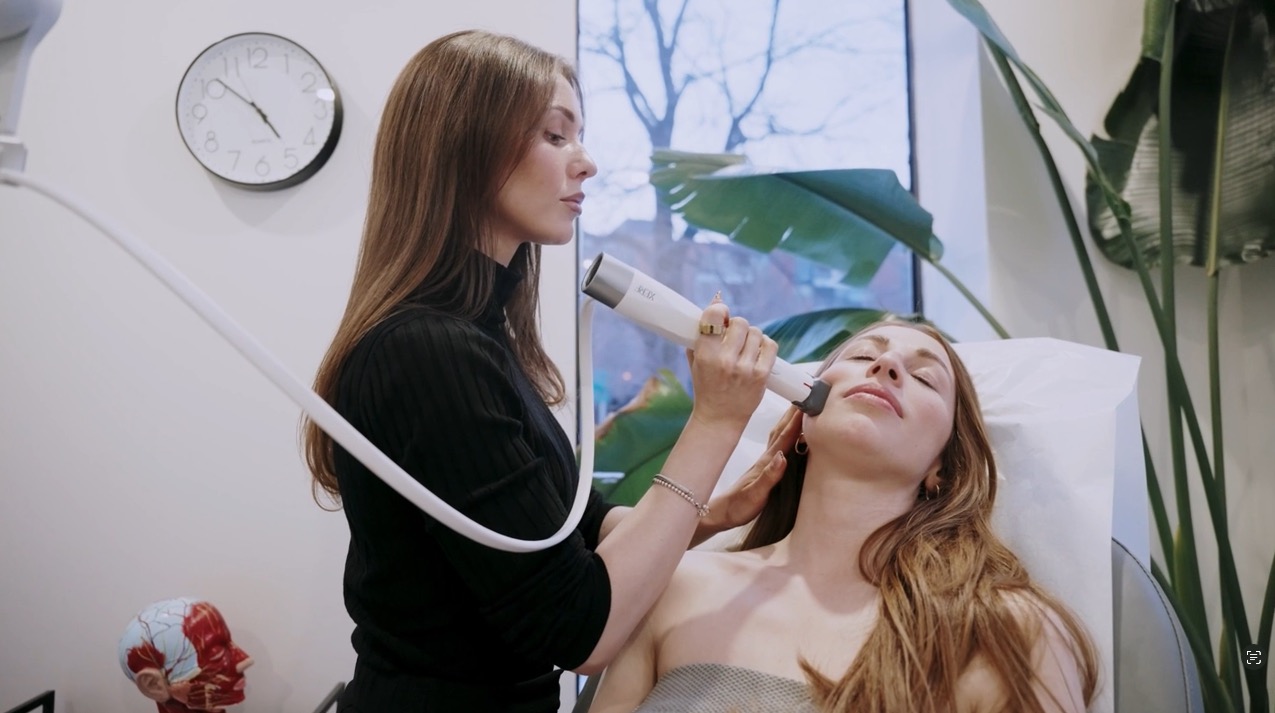

Perimenopause and Skin
In short: skin loses roughly 30% of its collagen in the five years following menopause, then about 2% per year afterward. Falling estrogen also reduces natural hyaluronic acid, thins the dermis and alters the skin barrier. The common result: dryness, laxity, uneven pigmentation and sometimes adult acne — all within a few years.
It isn't your imagination, and it isn't a question of discipline in your routine.
Why did my skin change so fast?
It's the sentence we hear most often in consultation: “my skin has never been like this before.”
The reason is hormonal. Estrogen plays a direct role in skin: it stimulates collagen production, supports hyaluronic acid synthesis, contributes to dermal thickness and participates in barrier function.
During perimenopause — which can begin several years before periods stop — estrogen levels become irregular, then fall. Skin loses several of its support mechanisms at once.
That's why the change feels sudden: it isn't a gradual decline spread over twenty years, it's a transition concentrated into a short window.
What exactly changes?
| What you notice | What's happening | Relevant approaches |
| Drier, tighter skin | Reduced hyaluronic acid, impaired barrier | Facials, adapted topical protocol, mesotherapy |
| Laxity, loss of firmness | Accelerated collagen and elastin loss | Monopolar radiofrequency (XERF), RF microneedling (Potenza), biostimulators |
| More visible fine lines | Dermal thinning, dehydration | Microneedling (Ultra), facials, topical protocol |
| Spots, melasma | Hormonal fluctuation and sun exposure | Pigment laser (DermaV), peel, strict sun protection |
| Adult acne, texture | Shifted estrogen/androgen ratio | Facials, peel, assessment in consultation |
| Dullness | Slowed cell turnover | Peel, microneedling (Ultra), facials |
| Volume loss, hollowing | Accelerated bone and fat resorption | Fillers, collagen biostimulators |
Collagen loss: the numbers
This is the most cited figure in dermatology on the subject, and it explains a great deal.
In the five years following menopause, skin loses roughly 30% of its collagen. After that, loss continues at about 2% per year.
Collagen is what gives skin its density and its ability to bounce back. When it drops quickly, skin appears thinner, less firm, and facial contours lose definition.
Two practical implications.
Creams alone aren't enough. A good topical protocol supports the barrier and hydration — that's real and useful. But no cream rebuilds deep dermal collagen.
Treatments that stimulate your own collagen become particularly relevant at this stage. Radiofrequency, microneedling and biostimulators all work on that mechanism.
Melasma during perimenopause
Melasma is hormonally influenced pigmentation, and perimenopause is a period when it frequently appears or worsens.
It differs from sun spots: more diffuse, often symmetrical, typically on the cheekbones, forehead or upper lip.
Important: melasma isn't treated like a lentigo. It behaves differently and can worsen with poorly chosen settings or excessive heat. Prior assessment is essential — exactly the kind of distinction our « Le Dôme » imaging system helps establish.
Daily sun protection is non-negotiable here. Without it, any pigment treatment is temporary.
And acne at 45?
It often surprises people, but it's common.
When estrogen falls, the ratio between estrogen and androgens shifts. That can stimulate sebum production and promote inflammatory lesions, typically along the lower face, jawline and neck.
This acne doesn't always respond to products designed for teenage acne, which are often too drying for skin that has become thinner and drier. It's a situation that merits assessment rather than trial and error at the pharmacy.
What genuinely helps, day to day
Fundamentals matter more at this stage, not less.
-
Sun protection. Broad spectrum, every day. Photoageing adds to hormonal ageing — the two mechanisms compound.
-
Sleep. It's often disrupted during perimenopause, and skin repairs primarily at night. That isn't a cosmetic detail.
-
Physical activity, particularly resistance training. Muscle mass and bone density also decline at this stage. Resistance training is the best-documented lever on both.
-
An adjusted topical routine. What worked at 30 may be too aggressive at 48. Thinner, drier skin tolerates actives differently.
An important note on hormones
Questions about hormone therapy, menopausal hormone treatment or medication belong with your family physician, your gynecologist or a qualified health professional.
We work on the skin manifestations. We don't prescribe hormones and we don't replace medical management of menopause.
If you're experiencing symptoms beyond the skin — hot flashes, sleep disruption, mood changes — those are conversations for your physician.
Where to start
There's no urgency, and there's no “too late.”
What we do observe: people who come in early in the transition have more options, because supporting existing collagen is simpler than rebuilding it after significant loss.
A Consultation 360 takes stock — what's hormonal, what's photoageing, what's routine — and establishes a staged plan. It's led by Amélie Castonguay-Hudon, nurse clinician, or by Dre Rita Mikhaël.
Frequently asked questions
At what age does perimenopause start? Typically between 40 and 50, though it can begin earlier. It lasts on average four to eight years before menopause itself.
Is it too late if I've been menopausal for ten years? No. Collagen loss is fastest in the early years, but collagen-stimulating treatments work at any age.
Do collagen creams help? Collagen applied topically doesn't penetrate to the dermis — the molecule is too large. Actives shown to affect collagen production work through other pathways.
Which treatment first? It depends on your dominant concern. Skin quality is often addressed before volume, and pigment protocols start more easily in fall or winter.
Is it covered by insurance? Aesthetic treatments are generally not covered by RAMQ or private insurance.
Important notice
This text is shared for informational and educational purposes. It does not constitute medical advice, a diagnosis or a treatment protocol, and does not replace consultation with a physician. Questions regarding menopause, hormone therapy and medication belong with a qualified health professional.
Book
Clinique AMÉ, 1 Place du Commerce, Suite 110, Nuns' Island (Verdun), Montreal.
Related reading: Aesthetics 101; Sunscreen in Winter: Why It Matters; The 360 Consultation