Your Cart
Your cart is empty.
Continue shopping
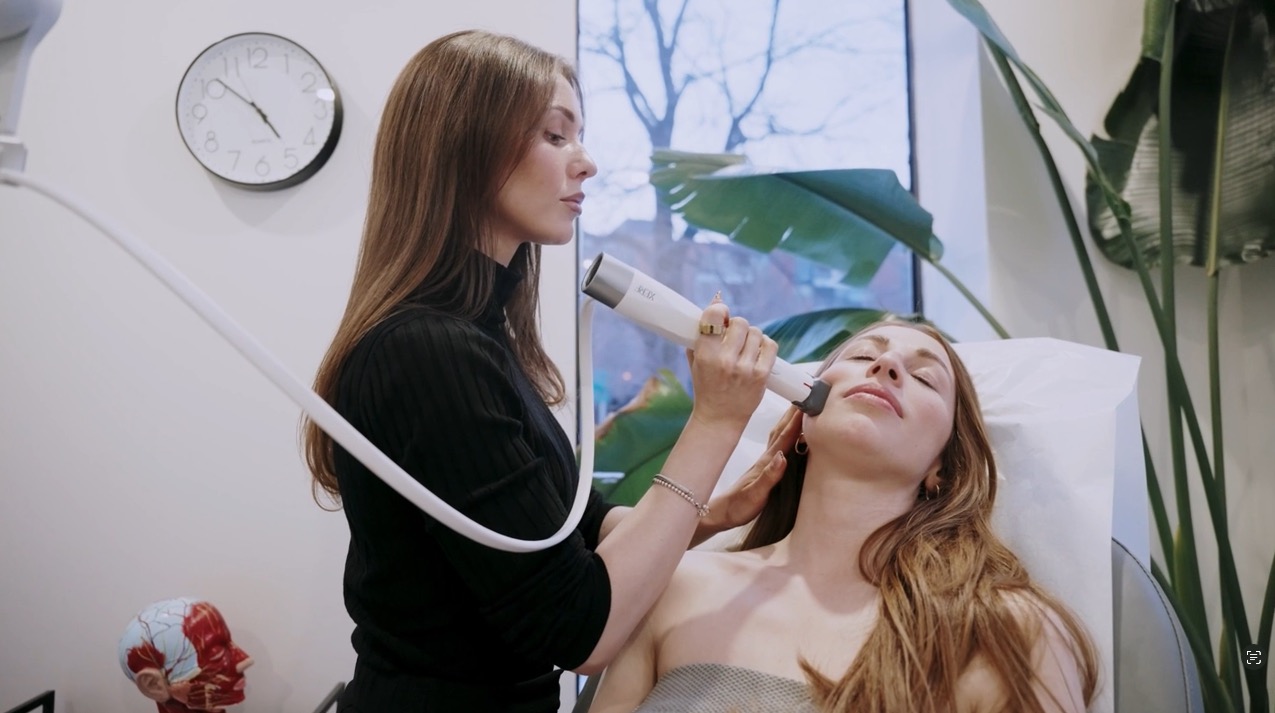

Redness, Rosacea and Sun Spots
In short: redness comes from dilated blood vessels visible beneath the skin; brown spots come from uneven melanin production caused by sun exposure. The DermaV vascular and pigment laser, used at Clinique AMÉ, treats both because it selectively targets haemoglobin and melanin without damaging surrounding skin. The usual protocol is two to three sessions spaced four to six weeks apart, with maintenance one to two times per year.
Here's the detail.
Why do I have redness on my face?
Persistent redness comes from blood vessels that have dilated lastingly and become visible at the skin's surface.
It shows up three ways: diffuse redness across the cheeks and sides of the nose, thread-like visible capillaries, or small well-defined bright-red angiomas.
Contributing factors include genetics, cumulative sun exposure, temperature swings, alcohol, certain spicy or hot foods, and sometimes underlying rosacea.
What all these forms of redness share: the haemoglobin in your blood.
Why do I have brown spots on my face?
Brown spots are clusters of melanin, the pigment that gives your skin its colour.
Under ultraviolet radiation, your pigment cells produce more melanin — a normal protective mechanism. Over the years, that production becomes uneven and concentrates in patches.
The result: lentigines (sun spots) on the face, chest and backs of the hands, uneven tone, and a general loss of radiance.
What these share: melanin.
How can one laser treat both redness and spots?
Through a principle called selective photothermolysis.
Different molecules absorb different wavelengths of light. The DermaV emits light that haemoglobin and melanin absorb strongly, while surrounding tissue absorbs it poorly. Energy therefore becomes heat within the target, and barely anywhere else.
In practice:
-
On a vessel — the wall heats, the vessel closes, the body reabsorbs it. Redness diminishes.
-
On a spot — the pigment cluster fragments, rises toward the surface and sheds with cell turnover.
That selectivity is what allows the target to be treated without harming the skin around it.
What concerns does this treatment address?
-
Diffuse facial redness
-
Visible capillaries and angiomas
-
Controlled rosacea — the visible vascular component
-
Sun spots and lentigines
-
Discolouration and uneven tone
-
Dullness and loss of radiance
Areas treated: face, neck and décolleté.
What laser doesn't do
This section matters as much as the last one.
It doesn't cure rosacea. Rosacea is a chronic condition. Laser effectively treats its visible vascular component, but the predisposition remains. Maintenance is part of the plan — and so is identifying your personal triggers.
It doesn't prevent new spots. Treating a lentigo gives your skin no immunity against future exposure. Without rigorous sun protection, new spots will return, often in the same places.
Melasma is treated differently. This hormonally influenced pigmentation behaves differently and can worsen with poorly chosen settings. Prior assessment is essential to distinguish a lentigo from melasma — two separate management paths.
Not every spot is benign. A pigmented lesion that is asymmetric, irregularly bordered, uneven in colour or changing in appearance must be medically evaluated before any aesthetic treatment. That point isn't negotiable.
How many sessions will I need?
Two to three sessions on average, spaced four to six weeks apart.
Maintenance: one to two times per year, depending on your sun exposure and goals.
The exact number depends on the intensity of the pigmentation or redness, your phototype and the area treated. At Clinique AMÉ, that plan is set with Amélie Castonguay-Hudon, nurse clinician, or Dre Rita Mikhaël. Settings are personalized — most skin tones can be treated with adapted parameters, and that adjustment is decisive for treatment safety.
What does recovery look like?
This is the part most clinics skip.
Immediately after: temporary redness, a sensation of heat, sometimes mild swelling. This generally settles within hours to a few days.
On treated spots: expect the pigment to get darker before it disappears. Spots often take on a darker, sometimes grainy appearance in the following days, then flake away naturally over one to two weeks.
That isn't a side effect — it's the mechanism working. But if nobody warns you, it's alarming to see.
On treated vessels: a transient purplish reaction is possible on more prominent capillaries.
Plan accordingly: if you have an important event, allow at least two weeks.
DermaV, microneedling or chemical peel: which one?
| Treatment | Primary target | Best for | Downtime |
| Vascular and pigment laser (DermaV) | Haemoglobin and melanin | Redness, capillaries, rosacea, sun spots | Light — redness for hours; spots flake 1–2 weeks |
| Microneedling (Ultra) | Collagen renewal | Texture, pores, scarring, fine lines | Moderate — redness 24–72 h |
| Chemical peel | Superficial epidermal layers | Dullness, texture, mild pigmentation | Varies with depth |
| Radiofrequency (XERF) | Deep collagen | Laxity, loss of firmness | Minimal |
These approaches are often complementary rather than competing. The sequence depends on your assessment.
Can laser treatment be done in summer?
Yes, but two conditions become strict.
No active tan at the time of treatment. Recently exposed skin contains more active melanin. The laser can't distinguish a tan from a spot — it targets pigment, whatever its origin. Treating tanned skin genuinely increases the risk of burns and post-inflammatory hyperpigmentation.
Strict sun protection after every session. Broad-spectrum SPF, daily, without exception. It's what separates a result that holds from one that fades in a single summer.
Fall and winter remain simpler periods to manage, which is why most pigment protocols start at that time of year.
Does it hurt?
The sensation is usually described as a brief elastic snap against the skin. Tolerance is generally good and no anaesthesia is required.
Frequently asked questions
When will I see results? Redness fades gradually over a few weeks. Spots lighten after flaking, roughly one to two weeks post-session. Full results are assessed at the end of the series.
How long is a session? Between 20 and 45 minutes depending on the area treated.
Is it suitable for all skin tones? Most phototypes can be treated with adapted settings. Prior assessment determines your eligibility and the appropriate parameters.
Do I need to stop my skincare beforehand? Certain actives — retinoids, acid exfoliants — need to be paused for a few days before and after. Full instructions are provided in clinic.
Do any medications cause problems? Yes. Several medications are photosensitizing. Disclose any current medication at your assessment.
Is it covered by insurance? Aesthetic treatments are generally not covered by RAMQ or private insurance.
Where to get this treatment in Montreal
Clinique AMÉ offers DermaV treatment at 1 Place du Commerce, Suite 110, Nuns' Island (Verdun), Montreal.
The treatment is open to direct booking. If you're unsure whether your spots are lentigines or melasma — two very different management paths — the Consultation 360 will settle it, supported by our « Le Dôme » imaging system.
Related reading: Aesthetics 101; The 360 Consultation; Sunscreen in Winter: Why It Matters